
Can Pauline do it?
Pauline Hanson has to be one of the greatest survivors of Australian politics. Now she’s doing much more than surviving.

There is the prospect of Pauline Hanson emerging as leader of the non-Labor/non-Marxist political forces in Australia. Can she do it?
The most recent national polling puts Pauline Hanson’s One Nation Party at 22 percent of voters choice. She is polling ahead of the Liberal Party. Related polls show One Nation would win 34 seats in the Federal Parliament, wiping out the Liberal/National coalition and forming the official opposition.
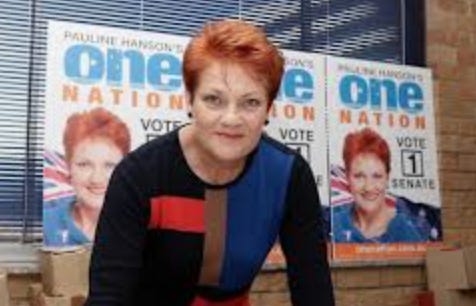
Let’s put this in context. For the last 80 years since World War Two, there have been several emerging minor parties who could have risen to challenge the dominance of the Australian two-party political system. The major ones have been the Democratic Labor Party (DLP), The Democrats and The Greens.
Most notably, each of these have risen to around 12 percent of the national vote at various times but have never exceeded that. Once reaching this height, they have fallen away. What’s significant about this latest polling for One Nation is that they have soared beyond 12 percent. This is historic in the post WWII period.
The Democratic Labor Party was formed from the split of the Australian Labor Party in 1955. I wrote about this in my last Substack Civil War in Australia -The How (8 January). The DLP was the political arm of an anti-communist, largely catholic movement, for many decades. The DLP was an important element in an integrated strategy aimed at keeping the Moscow/USSR directed Marxists in Australia from gaining domestic political power. Lead by several forceful catholic figures, the strategy was to frustrate Marxist power within the union movement and the Labor Party and limit Marxist parliamentary representation in Labor.
This was highly successful for about sixty years. At its peak, the DLP national vote edged toward 10 percent. Its real impact was denying the ALP votes, thus being a key to the long dominance of parliament/s by the Liberal/National coalitions. The DLP still exists but is a minor political player lucky to attract even around 1 percent of votes in any seat where it stands candidates.
The Australian Democrats, formed by Liberal defector Don Chipp in 1977, ran with the banner ‘Keep the Bastards Honest’. Chipp offered Australian voters an alternate to the two-party Coalition-Labor dominance. There was a time when the Democrats rise suggested that they could be a third equal political force to the two majors. They kicked off with 11 percent of the national vote in 1997 and for several elections kept this rate. They never pushed further. With the retirement and eventual death of Don Chipp, other leaders emerged exerting significant parliamentary influence through their control of the balance of power in the Senate. The Democrats remain an active party but are going through a progressive demise period similar to the DLP.
The Greens are the most recent attempt at a major third political Australian force. Formed by the charismatic environmental warrior Bob Brown in 1996, the Greens replicated the path of The Democrats, winning positions in the Senate. However, they took an important additional step that delivered lower house seats. In some electorates they secured more than 50 percent of the vote. They pivoted from being a single issue environmental party to building and riding on the re-rise of Marxism under the gentrification and social acceptance of ‘socialism’ (an alleged softer version of Marxism). I wrote about this in Australian Environmental Communism- Politically Unstoppable (October 2024) where I detailed how the modern Marxists booted out the traditional environmentalists from The Greens executive and controlling positions.
Like the Democrats, there was a period in which The Greens’ rise seemed unstoppable. Then they hit the brick wall of around 12 percent national voter support. The takeover of The Greens by organised modern Marxists activists, pushed their policies to the hard Marxist spectrum. A counterattack by the non-aligned political campaign organisation Advance focused on The Greens’ pivot away from environmentalism. Advance’s tagging of The Greens at the 2025 federal election as ‘Not who they used to be’ was powerfully targeted and resulted in the Greens losing several lower house seats. This seems to have halted The Greens’ surge with their national vote stuck at 12 percent.
There have been and continues to be a range of minor single-issue parties in the Australian political mix. It’s the three above though, who aspired at some points to challenge the majors, but have never broken through that 12 percent barrier.
Back to Hanson’s One Nation.
At the 2025 federal election, One Nation went from 2 senators to 4 on the back of a national vote of 6.4 percent that was pretty consistent in each state. Their recent polling of a 22 percent voter support suggests something bigger, but with caveats. First, opinion polls are not elections and there’s a long way to the 2028 federal election. Voter sentiment can shift quickly.
Second, One Nation’s surge polling is resulting from the collapse of the Liberal Party and National Party both as organisations in their own rights and as a coalition. Australians who are non-Labor voters are frustrated at the turmoil, division, splintering and confused and almost inane shifting policy positions of both parties.
I’ve argued that The Liberals are defunct. Read Death of the Liberal Party and A History of the Death of the Liberal Party. (June 2025). The Liberal Party death is not just another crisis of leadership through which all long-term political parties go, but something more basic and fundamental. Institutionally, the Liberal Party has collapsed. I explain this in detail in the two articles looking at the structure and operations of the party. The current, highly public infighting is, to be blunt, people fighting over a corpse hoping it will rise from the dead.
It’s on the back of this that One Nation is experiencing its surge. Now to an analysis of One Nation’s prospects.
The most important point about One Nation is the toughness of Pauline Hanson. She has to be admired for that at minimum. She can, and should, never be underestimated.
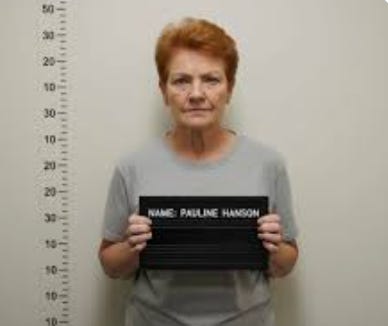
Most people forget that Pauline spent 11 weeks in jail of a 3 years sentence in 2003 on trumped up charges of electoral fraud. When tested in a higher court the charges were thrown out. Pauline was in effect a political prisoner and arguably the victim of an organised and orchestrated political and legal conspiracy to destroy her. There are parallels between her prosecution/persecution and that of the prosecution/persecution of Australian Cardinal George Pell. I’ve covered the motivations and reasons for Pell’s persecution in Civil War in Australia -The How (8 January). The difference between Pell and Hanson is that Pell was set up by the Marxist/Labor establishment in charge of Victoria, whereas Hanson was set up by the conservative/Liberal establishment nationally. In both cases, the (supposed) ‘independent’ justice system in Australia was weaponised for political outcomes.
I find it consistently amusing when Liberal Party operatives cry foul when One Nations does not preference the Liberal Party. Goodness, what do they expect! Pauline surely has a long memory of her treatment by Liberal powerbrokers.
For Pauline Hanson to come back from the treatment dished out to her; to not abandon politics; to not be emotionally crushed but to surge back, shows a person that is tough. To turn this toughness, resilience and persistent focus on objectives into a major political presence requires much more than a high profile.
There are significant organisational elements that are necessary for any political party to become an ongoing major force. This really is the challenge facing Pauline Hanson at this point.
Even though successful parties require quality leaders, the party has to be bigger than just the leader. The Democrats have not sustained themselves as even a potential major political force beyond their founder Don Chipp. They tried but failed. The Greens look to have hit trouble after rejecting the Bob Brown ethos and direction. Certainly, the powerful personality of Robert Menzies forged the Liberal Party into a long-term power. The Liberals formed from a coming together of 18 existing non-Labor parties. That is, they already had a formidable organisational structure from the beginning.
Having the political infrastructure and organisation is critical to long term survival and success as a party. There are basic elements that are needed.
Candidates must be run in every seat in every election in every state. Without this, party branding and core, solid ongoing voter support is near impossible.
Every polling booth in every election in every state must have people, usually volunteers, handing out how to vote cards on election day and at pre-polling otherwise voters don’t know how to vote for the party.
The list of essential administrative tasks to be managed on scale is endless and tedious. For example, just ensuring that every candidate lodges their nomination form with the electoral commission correctly and on time requires disciplined organisation.
If One Nation cannot organise these essential functions listed above and more, the 22 percent surge in support can and could dissipate quickly. Pauline Hanson has proven that she should not be underestimated. A lot depends on how she views her strategy and what she seeks to achieve. This will determine the type of organisation she needs.
For example. Does she only seek to be a party orientated to the federal parliament? If One Nation won substantial seats in the lower house, would she remain in the Senate or seek to move to the lower house? Does she seek to be a major player in each of the state parliaments and if so that takes the organisational need to a much higher level.
At the Federal level, One Nation has one of the most professional and effective support teams in and around Pauline. That shows a level of impressive organisational capacity. At the state level it’s more chaotic.
Pauline’s first test is how One Nation performs at the South Australian election on 21 March 2026. One Nation’s state leader says they will run candidates in every one of the 47 seats. This is despite an existing One Nation state member of parliament have a big fallout with Pauline and setting up an opposition party to One Nation. Plus, the organisation will need to move super-fast to become organised in less than two months.
A bigger test is likely to be how One Nation performs at the 2026 Victorian state election on 28 November. This is so because there’s more time to organise. This will test the capacity of the One Nation party as a political ‘machine.’ On the back of the polling surge, a series of One Nation branch formation meetings have been held across Victoria. Several hundred people have turned up at each, but the reports are one of organisational confusion, no structure to the meetings and so on and people have left. But that’s early days. Organisation can come out of confusion.
One Nation has had attempts at securing sustained presence in each state over the years. Even with occasional success at winning state parliamentary seats, the local organisation has tended to die off.
This time it is different. For the last 80 years. a minor party has never surged in support past either the Liberals/National coalition or the Labor Party. The Liberals and Nationals are in major decline heading toward minor party status themselves. Maybe they can revive? The Liberals at least are confronting a crisis of a scale that they don’t understand and refuse to admit. Can Pauline Hanson’s One Nation replace the Liberals as a major political force? We can only watch!

I adore her. Unlike the liars and grifters of the Terrible Two, she genuinely wants to heal this country and lift it up to the prosperity and freedom we should have had. I want to see her PM before I die.
We're two years from the next federal election - a long time to build something, a long time to slowly fail too.
Although PHON has a long (chequered) history, that may be good or bad for them, depending on how they capitalise on that. The election is likely to need more than just PHON populist policies that seem to resonate today, they will actually have to have a sensible and broad policy platform to attract the centre majority who are looking for the replacement to the Lib / Nat coalition.
That PHON is (currently) the only brand name alternative for those who will never vote Labor is probably what we are seeing in the polling.
If they can develop a suite of policies that resonate, and get beyond the organisational culture of the 'cult of personality' leader as the driving force, they may maintain a viable position. Two years is a long time in politics, and a lot is likely to happen both domestically and globally to change the economic and social landscape that voters will find themselves living in by 2028.